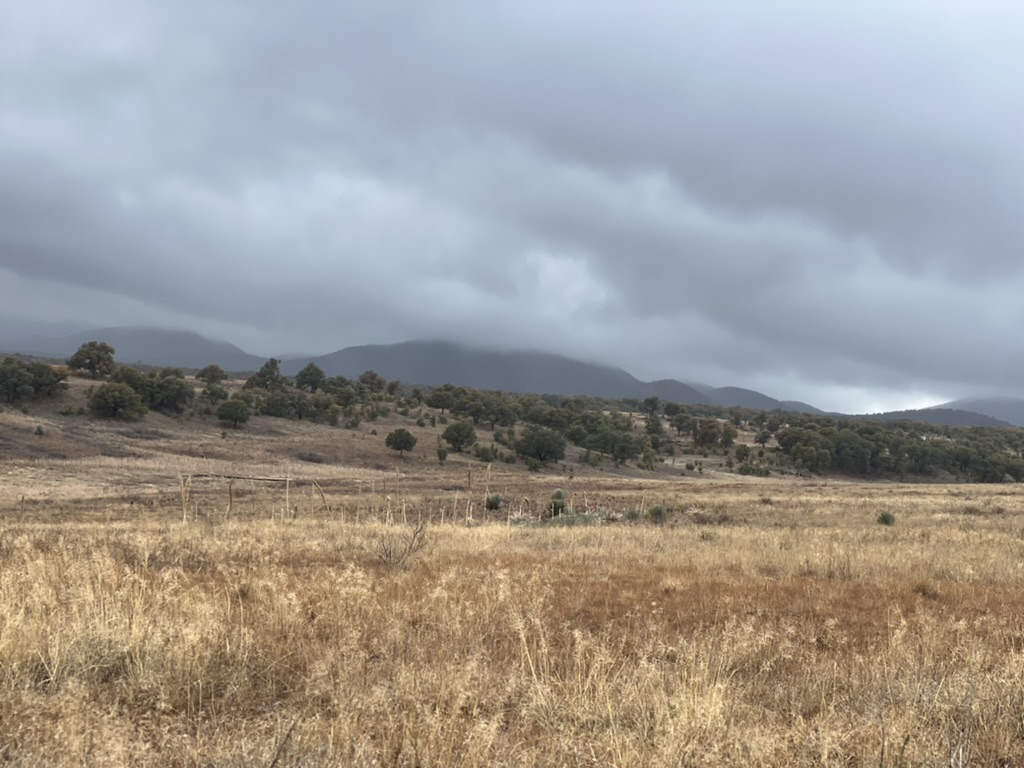
The January Mine is a direct threat to the health of the historic headwaters of the Santa Cruz River. This is a unique and vulnerable part of our watershed that is crucial to the health and longevity of our border communities – both human and beyond.
The land downstream from the January Mine “Hermosa Project” is known as the Canelo Hills Cienega. Historically, the tributaries running through the rolling grasslands began the contributing headwaters for the Santa Cruz River as water collects in the San Raphael Valley.
This landscape supports a rich tapestry of wildlife and culture woven through the creeks and the arroyos. These are the mountains where Jaguar visit as they cross la frontera.
Water run off from the January Mine flows directly into tributaries that serve as a direct water source borderland wild life such as; coatimundi, white tailed deer and bobcats and, likely, jaguar. Further more this water flows into the wells and aquifers that support human communities such as Patagonia. The long term effects of the project on regional public and environmental health is unknown.
CALL TO ACTION
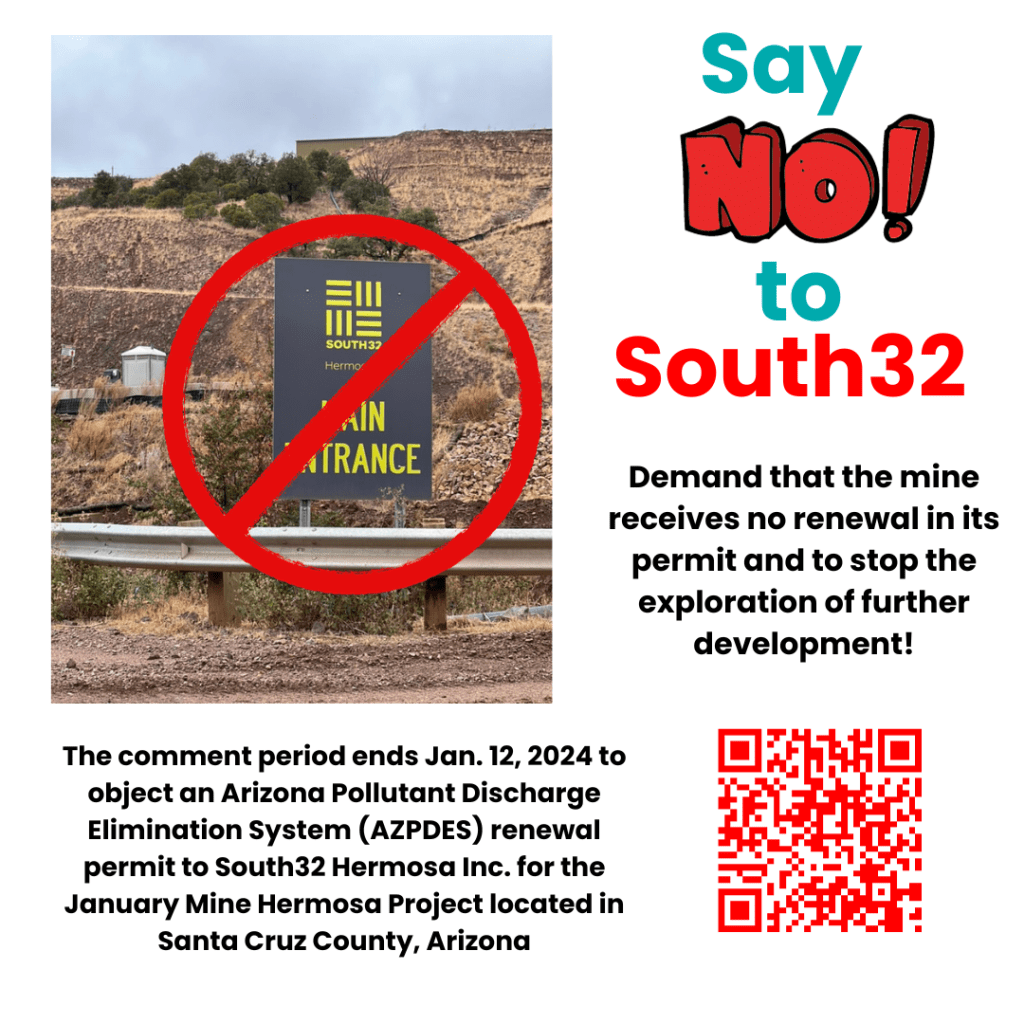
Link to public comment – https://azdeq.commentinput.com/?id=6kNd5JVUs
Time is running out for public comment to demand that the mine receives no renewal in its permit and to stop the exploration of further development.
The comment period ends Jan. 12, 2024 to object an Arizona Pollutant Discharge Elimination System (AZPDES) renewal permit to South32 Hermosa Inc. for the January Mine Hermosa Project located in Santa Cruz County, Arizona.
If you are in Santa Cruz County please attend the In-Person at Public Hearing and object to any renewal or expansion of the January Mine.
Date: Thursday, Jan. 11, 2024 at 6 p.m.
Location: Patagonia Union High School, 200 Naugle Ave, Patagonia, AZ 85624
Mail in your statement – letter must be postmarked or received by Jan. 12, 2024):
ADEQ Water Quality Division, Surface Water Protection
Attn: Rachel Heinz
1110 W. Washington St.
Phoenix, AZ 85007
MANGANESE POISONS THE SANTA CRUZ RIVER WATERSHED
Policy such as the U.S. General Mining Law of 1872 allows corporations to extract minerals free of charge while actively degrading the environment. These laws allow corporations like South32 to continue poisoning our homes with little to no consent or accountability.
South32 Hermosa Inc. is an Australian mining corporation, that is the proprietor of the January Mine Hermosa Project located just Southeast of the town of Patagonia. South32 Hermosa Inc. recently proposed a rezoning in Rio Rico to explore the possibility of a manganese processing plant along the floodplain of the Santa Cruz River that was handily rejected by the community. The threat of manganese poisoning still lingers. Manganese is used for steel production and lithium batteries for electric vehicles.
Manganese exposure is directly associated with Parkinson’s disease. Manganese blisters can be caused by handling the substance. Manganese dust, or powder, is a neurotoxin that directly effects your brain not effects your fine motor skills and effects an individual’s everyday function.
American Journal of Industrial Medicine Volume 65, Number 1, January 2022 published an article documenting a link between manganese exposure and parkinsonian symptoms with in South African Mining communities. 40% of workers that participated in the studies showed signs of Parkinson’s. The average age of mineworkers was 42. Mining towns like Hotazel, South Africa were cited as hotspots for manganese exposure related symptoms. Many of these workers in these communities were employed at South32 Hermosa Inc. mines and facilities.
How will the development in Southern Arizona be any different than South Africa? Why should we, the residents of the borderland have any trust in a cooperation like South32 Hermosa, or any industry for that matter, that knowingly poisons their workers and the land?
To learn more and hear the perspectives of victims from communities harmed by the negligence of South32 Hermosa Inc, their stories have been soundly reported in a story titled Manganese Road done by South African Journalists.
 tierra y alma